
How to Get a Direct Mail Mailing List
The mailing list is the single most important part of any direct mail campaign. You can’t create an appealing offer or design a beautiful piece without knowing who you’re mailing to. And if you send your pieces to the wrong audience, you risk alienating prospects and wasting valuable time and money.
If you’re new to direct mail or want to know how to improve your list selection for future campaigns, you’ve come to the right place. Follow the steps below to learn how to determine your audience, select a mailing strategy, and obtain the perfect list. We’ll also provide a handful of questions that can help you choose the right list provider. Let’s dive in.
Determine Your Target Audience
The first step of any direct mail campaign is to determine your target audience. You have to know who you’re mailing to before you can choose a mailing strategy or obtain a direct mail list. In fact, determining your audience is arguably the most important aspect of direct mail and influences almost every decision you make about your campaign.
Once you know who you want to reach, you can segment or filter your mailing list based on a variety of selects. Selects are specific criteria that help you narrow your list down into more refined groups. There are five main ways to segment your mailing list.
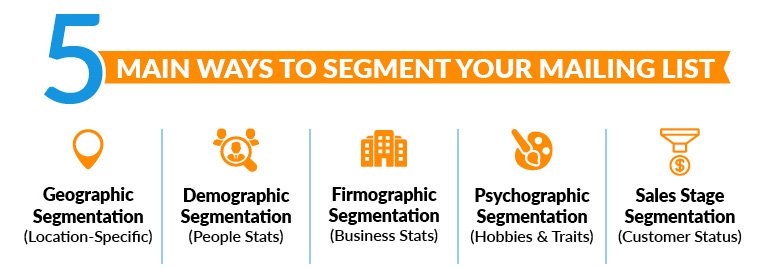
In some cases, you might need to use multiple segmentation methods at the same time. For example, you may want to mail to all people within a 5-mile radius of your business who are between the ages of 35 and 50. In this case, you’d be combining geographic and demographic segmentation.
Choose Your Mailing Strategy
The second step in getting your list is selecting a mailing strategy. The goals of your campaign and the complexity of the segmentation method(s) you choose will determine how you mail.
This table shows the relationships between the five segmentation types and the two main mailing strategies. We’ll get into the specifics of each mailing strategy below.
| Mailing Strategy | Geographic (Location-Specific) | Demographic (People Stats) | Firmographic (Business Stats) | Psychographic (Hobbies & Traits) | Sales Stage (Customer Status) |
|---|---|---|---|---|---|
| Saturation Mailing | ✔ | ✔ | × | × | × |
| Targeted Mailing | ✔ | ✔ | ✔ | ✔ | ✔ |
Saturation Mailing
If your business offers a product or service almost anyone can use, a saturation mailing is probably your best bet. Consumer-facing businesses like restaurants, grocery stores, and automotive shops can benefit from a saturation mailing strategy.
If you choose saturation, your pieces will be sent to every household along a particular carrier route (the actual route the mail carrier walks or drives). Saturation mailings also allow you to do some targeting. For example, you can remove business addresses, PO boxes, and some residential addresses (like drop addresses, seasonal addresses, and apartments). You can also use the median demographics (like age, income, and number of children) for each carrier route to do some further targeting.
Keep in mind that the demographic data provided for carrier routes is expressed in medians, which are the figure(s) in the middle of a data set. If you only want to target people who are exactly 50 years old or households with exactly 2 children, then you’ll need to go with a targeted mailing.
In some cases, saturation can actually offer better returns than targeted mailings. Because you can view median demographics for carrier routes, you can reach a similar audience with a saturation mailing as you would with a targeted one. Your targeting might not be as refined, but you’ll save money because you won’t need to pay for a more expensive targeted list. Plus, you’ll qualify for lower saturation postage rates.
Saturation Mailing Summary:
- Pros: Low cost, reach everyone in a neighborhood, remove certain address types
- Cons: Doesn’t offer extensive targeting, no personalization
- Works well for: Consumer-facing businesses like restaurants, grocery stores, car washes, etc. and large retailers
Targeted Mailing
Unlike saturation mailings, a targeted strategy allows you to segment your list based on a variety of selects. One of the most common uses of a targeted strategy is mailing to your current customers or loyalty rewards members. If you want to be more specific with your targeting, you can combine different audience segmentation methods to reach a more qualified audience. For example, you might combine demographic and psychographic data by mailing to men between ages 25 and 40 who like golf.
Depending on how much you’ve segmented your list, you might end up mailing to only a handful of people who fit the very specific criteria you’ve selected. Targeting allows you to extensively filter lists based on specific personal details, but don’t abuse that power. Your audience takes their privacy seriously, and they probably won’t respond to an offer that feels too invasive.
While targeted mailings are more expensive than saturation ones, they’re usually well worth the investment. You can create a more relevant offer by tailoring your message to meet the needs of your ideal customer. And higher relevance often leads to greater engagement with your piece and improved response rates.
Targeted Mailing Summary
- Pros: Ability to target an audience that may be more receptive to your offer, ability to personalize your direct mail
- Cons: More expensive than saturation mailing, over-personalization can come across as creepy
- Works well for: Businesses offering a niche product or service or companies mailing to an existing customer list
Ways to Obtain a Mailing List
Once you’ve decided on your audience and mailing strategy, it’s time to actually acquire your list. There are two main ways to go about this: use your own house list or pay to rent or buy one.
Use Your House List
Your house list is a great place to start if you don’t know how to get addresses for direct mail. This list contains the names of people you already have a relationship with. These individuals can be current customers, past customers, or people who’ve inquired about your product or service. They’re part of your target audience, and they’ll probably be responsive to your offer. Best of all, you don’t have to rent or buy a mailing list when you use in-house files, which saves you money.
If you use your house list, remember that you need to keep it clean and up to date. You can either hire an external company to do this or have one of your current employees handle it. The process of keeping your lists free of incorrect information, duplicate names, and other inaccuracies is called data hygiene.
It’s important to keep organized records of everyone who comes into your business or contacts you for information. If you have a large house file and want to narrow it down, try applying some of the segmentation methods mentioned above to make it easier to navigate.
Buy or Rent a List

Names on compiled lists come from a variety of sources, including:
- Associations – professional/trade organizations, membership organizations, trade shows/events, etc.
- Subscribers – magazine or newsletter subscribers, subscriptions for recurring services/deliveries, etc.
- Buyers – proven buyers of products and services similar to yours
- Other data sources – directories, public records, warranties, product registrations, surveys, etc.
Where to Get a Mailing List
If you decide to rent or buy a mailing list, you need to know where to get it. If you use a full-service direct mail company, they should obtain a list for you. But if you’re responsible for finding your own and don’t know how to get mailing list addresses, there are several resources you can use for mailing list rental.
- List Brokers – Perform extensive research to provide you with recommendations based on the goals of your campaign. Direct mail list brokers have the experience and knowledge to find the right list for you and will advocate on your behalf.
- List Compilers – Manage the lists they’ve compiled and market them to potential clients.
- List Managers – Oversee the rental of specific lists they manage themselves. They advertise their lists to convince clients to rent them.
- List Managers/Brokers – Manage and broker lists at the same time. Since they might be promoting their list over others you’re considering, take what they say with a grain of salt. Make sure they’re working for you, and not just themselves.
- List Owners – Sell lists that have performed well to non-competitive companies.
How Much Do Mailing Lists Cost?
List prices can range from a penny to well over a dollar per name depending on the type of list you choose and how it’s segmented. For example, lists for targeted mailings will cost you more than lists for saturation mailings. And lists that are segmented using psychographic data or sales stage information will probably be more expensive than lists segmented demographically or geographically.
Depending on where you get your list, you may have to purchase a minimum amount of names. And if you want to test a small portion of names ahead of time, you’ll probably have to pay extra up front.
To make sure you don’t overspend on your list, gather a few estimates from different companies before purchasing. You should never buy a list based on cost alone. Otherwise, you could end up with a low-quality list that doesn’t perform just because you wanted to save a buck.
Saturation Example
- Criteria: Your ZIP Code
- Number of Addresses: 5,000
- Cost per Address: $0.04
- Total List Cost: $200
Targeted Example
- Criteria: Your ZIP Code, Women, Ages 25-30, Cat Enthusiasts, Photography Enthusiasts
- Number of Addresses: 50
- Cost per Address: $2.50
- Total List Cost: $125
Questions to Ask List Providers

Conclusion
Reaching the right people is crucial to the success of your direct mail campaign. But that’s easier said than done. We hope this guide helped break down what can be a complicated process into some easy, actionable steps.
If you ever find yourself stressing over your list, just remember the three simple steps outlined above. Decide who you’re trying to target. Choose a mailing strategy that complements your target audience. And obtain your list by using your own house data or renting from a provider.
As you become more comfortable with list selection, you may want to begin testing different mailing lists against each other. This will help you evaluate your list performance and optimize your direct mail spend. To learn more about how to set up testing, check out our guide on how to analyze and test direct mail campaigns.